Town castle Banská Bystrica was built on a hill, at the crossroads of the important trade routes “Via Magna”. The castle was the seat of the town’s high officials, the town clerk and representatives of the church. It housed the town’s most valuable treasures and had mainly a defensive function. Over time, the fortifications of the castle were built gradually. In the 13th century, the parish Church of the Assumption of the Virgin Mary began to be built. The other sacral buildings were added later around the church. The Pretorium (where the town governor and the town council rooms were located), Matej’s house and the Church of st. cross were also part of the complex. In the underground there was a prison and a torture chamber.
Parts of the castle
Town castle Banská Bystrica consisted of a fortification, which also consisted of 4 circular bastions. 3 of them have survived to the present day. The Barbican, which was completed in 1512, was also an important part of the castle. In the Barbican, an entrance gate to the castle was built through two portals, to which a drawbridge led over a 4-metre-high moat. The entrance consisted of two separate portals – the smaller portal was used for pedestrians, the larger one for carriages. Even today, above the two portals in the center, you can still see the openings through which the defenders of the castle used to pour their bad luck on the enemy. The town hall was also incorporated into the town castle over time.
The Barbican and the surroundings of the town castle form a symbol of the historical center of Banská Bystrica. They were declared a national cultural monument. Today, the Barbican houses a restaurant.
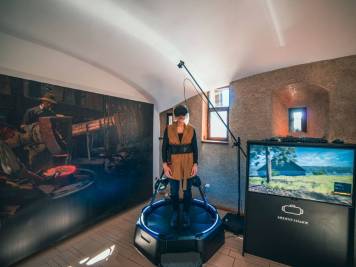
TIP: Additionally, don’t hesitate to visit the THURZO – FUGGER interactive exhibition in the Barbican, which brings the mining history of Banská Bystrica and the surrounding villages and towns, especially from the times of the famous Thurzo-Fugger Company and the Copperworks, to life in an interactive and engaging way. If you are into the art, you should definitely go to the Central Slovakia Gallery in the building of Pretorium. While in the Matej’s house, one of the exposition of the Central Slovak Museum, you’ll find out about the history of Banská Bystrica.